
Production Management Board
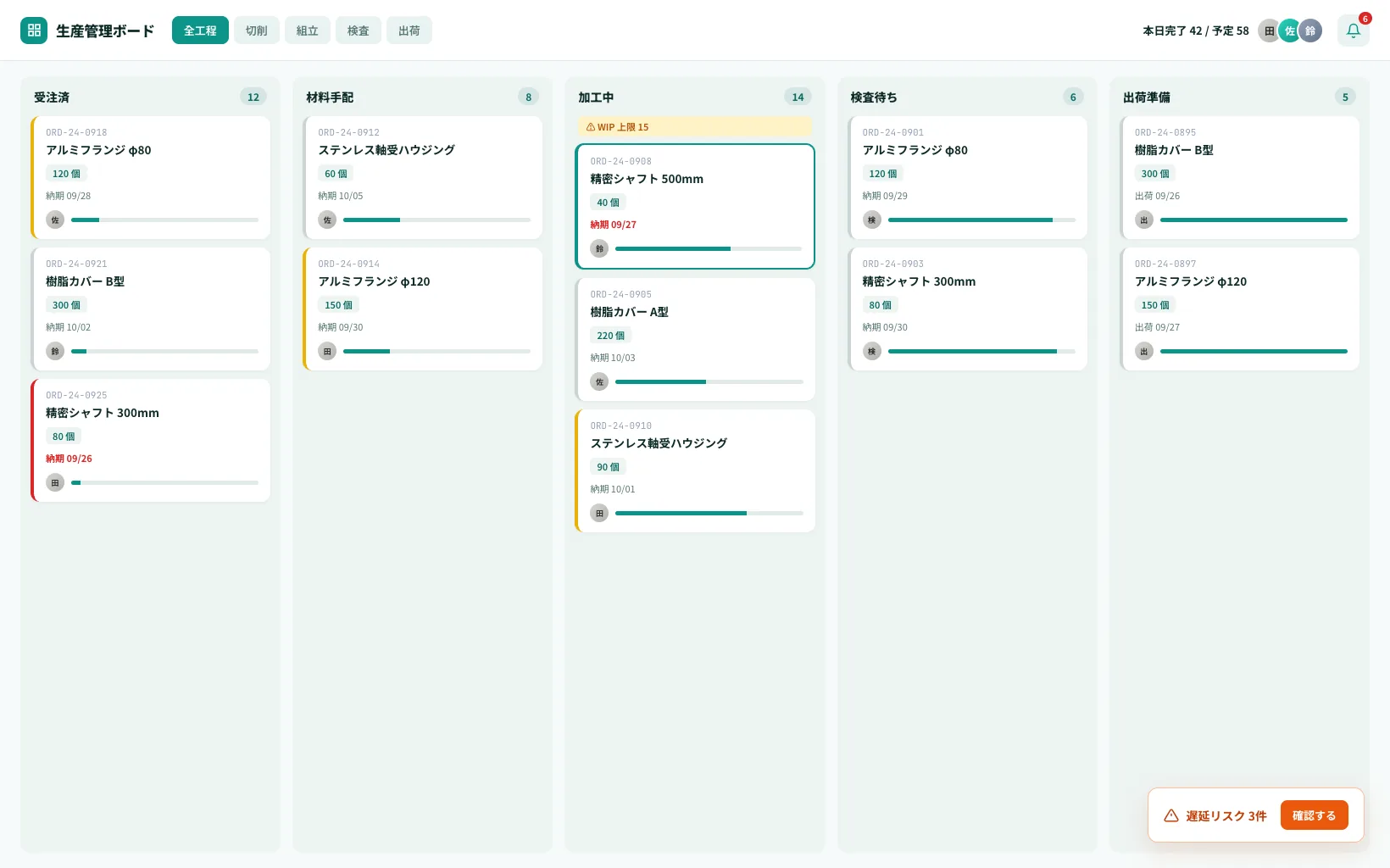
Moved process stages from order to shipment onto a board to make progress visible.
- Timeline
- About 5 months
- Team size
- 4 people
- Platforms
- Web · Server
- Scope of management
- Order intake through pre-shipment processes
Background
From order intake to shipment, tracking which stage each process was at relied on a shop-floor whiteboard and staff memory. As the number of processes grew, it became harder to tell which stage was currently causing delays.
Scope
- Order registration and process stage definition
- Progress board by process stage
- Display of delayed processes
- Scheduled shipment date management
- Process history lookup
Technical decisions
What we chose, and why it fitMoved the whiteboard approach directly into a board-style screen, while designing the underlying data structure from scratch
Floor staff were already used to checking on process stages by moving items across a whiteboard. We kept the familiar interaction on screen while redesigning the underlying data to preserve process-transition history, so we could later trace which process stage delays repeated at.
Stored process-transition history in PostgreSQL, timestamped by event
Storing only the current state could not answer questions like which process had frequent delays this month. We logged history at every process transition, accumulating data that let us look back at delay patterns later.
Engineering challenges
Problem
With multiple staff handling processes, the state got tangled when more than one tried to move the same order to the next stage at the same time.
Approach
We applied optimistic locking to process stage transitions, so only the first move was applied and later requests had to re-check the latest state.
Result
Process stages stayed consistent even when multiple staff handled the same order at the same time.
Problem
Process stages varied slightly by client or product line, so a single fixed list of stages couldn't represent every order.
Approach
We configured process stages as selectable templates per order, letting staff choose the stage configuration matching each order at registration.
Result
Even as product lines grew, they could be handled by adding a new process template, with no development needed.
Handover and operations
We provided a board usage guide for floor staff and a process template registration method, in Japanese documentation. We handed over the source code and deployment configuration, and supported new process template additions under separate maintenance.